Friday, October 29, 2010

Bloody Sunday

Film: Bloody Sunday (2002)
Dir: Paul Greengrass
Rating: **** out of 5 stars


On January 30, 1972, a peaceful march was planned in the Irish town of Derry. It was one of many events staged by residents of Northern Ireland to protest English oppression. A British paratrooper regiment was put in place with orders to quell a potential uprising and make arrests. During the demonstration, a few rebellious teenagers threw stones at the soldiers, resulting in a small riot. During the confusion, the British Army command center received reports of a possible IRA sniper in the area. The paratroopers subsequently entered the Bogside area and began firing into the crowd of civilians. Thirteen Irish were killed and fourteen wounded. All the victims were unarmed and many were shot in the back while fleeing. The subsequent inquiry by the British defended the actions of the paratroopers, justifying the shootings as self-defense.

The incident has been forever immortalized as “Bloody Sunday.” It was a devastating tragedy, made worse by the fact that justice has yet to be served for the victims. British writer/director Paul Greengrass captures the incident with striking fidelity. Shot on a hand-held camera, the film feels almost suffocating, like watching a horror movie. The story is divided between three perspectives – the Army command center; the paratroopers; and the protesters. This is a very effective design and it feels less biased. In the film, not all British are portrayed as monsters, nor are all Irish portrayed as saints. The paratroopers believed they were up against a real enemy, and like the protesters, they too were scared. This honesty makes the film feel that much more real.

Leading the march was politician Ivan Cooper, who is portrayed by James Nesbitt in Bloody Sunday. Cooper, a major player in the Irish civil rights movement, believed in non-violent protest and very much wanted to avoid a conflict that Sunday afternoon. The emotional impact of the “Bogside massacre” (as it is also known) is visualized through Cooper in the film. He is the walking embodiment of Irish liberation, and the January 30th incident takes a crushing toll not only on him personally but on the rights movement itself. Furthermore, the actions of the British only served to galvanize the Irish Republican Army, with whom he strongly disagreed. As Cooper, Nesbitt is a very likable moral center, and when the weight of the situation is upon him, his eyes recall the intensity of a young Jack Nicholson.

Writer/director Paul Greengrass delivers a powerful script and his usual gritty visual style. His script focuses on some characters closely – including Cooper; one of the shooting victims; and a reluctant British soldier – in order to help the viewer become emotionally invested in these people and not get swept away by the scale of the tragedy. The hand-held camerawork is very effective at creating tension and fear, putting the viewer right there on the streets of Derry. However, Greengrass does have a tendency to cut excessively which can be off-putting. The film skips around and scenes often fade to black before they feel complete. Granted, the effect gives the film the look of actual footage that has been haphazardly spliced together, but such hyperactive editing is also a bit distracting to the viewer.

The events of that day and what they represent still resonate today with Irish and non-Irish alike. Countless artists and musicians, including U2 and John Lennon, have paid tribute to the victims. Bloody Sunday too is a fitting artistic tribute to a piece of history that must never be forgotten. In June of 2010, the British prime minister apologized for the shootings on Bloody Sunday following a report that decreed the paratroopers were not justified and that innocent, unarmed civilians were gunned down that day. Perhaps artists’ renderings such as this film have bolstered support for the cause and are now hopefully bringing peace to the families left behind.

Wednesday, October 27, 2010

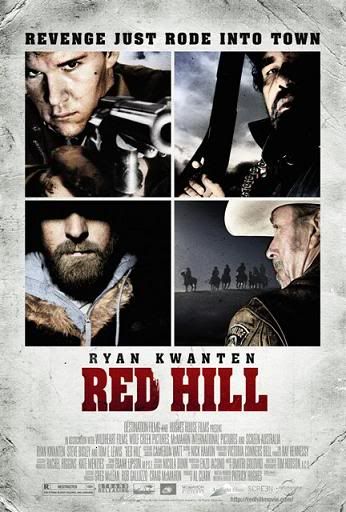
Red Hill

Film: Red Hill (2010)
Dir: Patrick Hughes
Rating: **** out of 5 stars


The western film is a genre rarely seen anymore. Gone are the days of John Wayne and duels at high noon. This decline is probably due to audiences' general lack of interest in period pieces. But Westerns do not necessarily have to take place in the Old West. A film need only encompass the themes of a western to fit the genre, though a rural setting does help. Australia is an ideal location to set a modern western because much of the country is still undeveloped, sparsely populated, and even dangerous. The “wild wild west” of yesteryear is now the great Australian outback. Patrick Hughes must have recognized this when he made Red Hill, a cleverly-written and action-packed western set in a small Australian town.

Australian police constable Shane Cooper (Ryan Kwanten) moves from the big city to a (literally) one-horse town called Red Hill. Here he hopes to find peace and quiet for him and his pregnant wife. Cooper is immediately disliked by his boss, gruff Chief Inspector “Old Bill” for being a doe-eyed city slicker with an aversion to violence. Cooper is barely in town for a day when the news breaks of an explosion at a nearby prison. One particularly dangerous convict is reported to have escaped – Jimmy Conway, who was put away for life by Old Bill. The locals gather up their guns and brace for a visit from Jimmy who, as Bill puts it, “is coming back to town and bringing Hell with him.” Cooper finds himself in the middle of a firestorm as Jimmy indeed wreaks havoc on the small town and unveils some of its dark history along the way.

Writer/director Patrick Hughes brings back revenge westerns in a big way with his feature film debut. The movie recalls gritty classics by Sergio Leone and Sam Peckinpah. Hughes’ story hits all the genres familiar clichés but in the best possible way: we get the dark stranger riding into town; the honorable protagonist (appropriately named Shane) defending truth and justice; and a town with so many secrets it is practically a character unto itself. These are old archetypes and the story is a bit predictable, but the script is tightly written and steeped in Australian history.

The film subtly addresses issues such as the impact of industrialization on Australian natural resources and the treatment of the native Aborigines. The script has a surprising amount of depth for an action-packed western. There is even a strong visual metaphor in the film that can easily be misunderstood if one does not consider the deeper themes of the story. It is a bit heavy-handed, and the film probably could have omitted it altogether, but Hughes had good intentions.

Kwanten is best known for playing resident heartthrob Jason Stackhouse on HBO’s “True Blood.” The Aussie actor is one of the best parts of that television show, completely disappearing into the role of the Southern bad boy. In Red Hill, he further proves his acting chops as wet-behind-the-ears Constable Cooper. He fulfills the familiar role of an honest lawman thrust into strange territory up against an unstoppable menace. Kwanten makes a good action star without sacrificing charm and sensitivity. Cooper prefers diplomacy to a bullet, much to the chagrin of his new co-workers, but they underestimate his ability to lay down the law.

As Jimmy Conway, Tommy Lewis (The Proposition) is one frightening, badass villain. With a scarred face and a black leather duster, he rides into Red Hill looking for the men who put him behind bars, prepared to strike down anyone who stands in his way. Another great performance comes from Steve Bisley (Mad Max) as Old Bill. As the local authority with whom Cooper butts heads, Bisley gets to be something of a villain himself. He is crotchety veteran of the force who is set in his old ways, which can be a dangerous thing for a fish-out-of-water like Cooper.

Red Hill has some stunning cinematography courtesy of Tim Hudson. The wild Australian landscape makes the perfect setting for a violent western, and Hudson knows how to shoot it beautifully. Dmitri Golovko’s score also sets the mood just right for a bloody clash down under.

The film is produced by Wolf Creek director Greg Mclean, who is often credited with revitalizing Australian genre films. Perhaps that distinction would be better reserved for Patrick Hughes. While Mclean’s horror movie attempted (poorly) to revisit the Ozpolitation trend of the 1970s/1980s, Hughes’ western is helping to put Australia back on the map as a source for solid cinema. The writer/director has a strong future ahead of him and hopefully there is the truth to the rumor that Red Hill is only part one of a thematic trilogy.

Tuesday, October 26, 2010

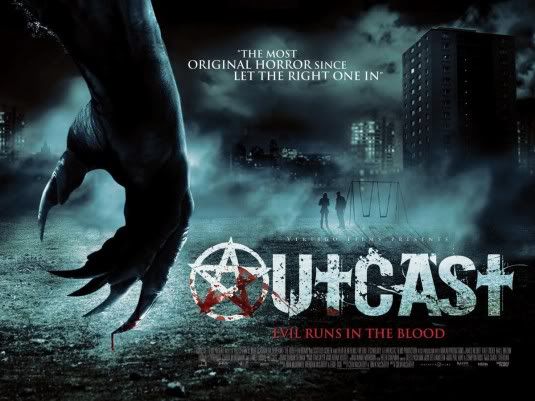
Outcast

Film: Outcast (2010)
Dir: Colm McCarthy
Rating: ***1/2 out of 5 stars


Outcast does not look like much based on its trailer and premise, but this modest little horror film may surprise you. It is a love story, a supernatural thriller, and a monster movie all in one. Don’t worry, it is nothing like Twilight. The film is occasionally convoluted and odd but strong performances and a unique story make it worth a look.

The tale begins with Fergal, an Irish teenage boy, and his mother Mary moving into a run-down apartment complex in Edinburgh, Scotland. They move next door to Petronella, a fiery teenage girl with an alcoholic mother and a mentally handicapped brother. The girl begins to take a romantic interest in her new Irish neighbor. What she does not know is that Fergal harbors a dark secret that keeps him and his mother on the run.

Two Irishmen, Cathal and Liam, are on the hunt for the pair, using black magic along the way to find them. While Petronella and Fergal are having secret rendezvous, Mary paints pagan symbols in blood on the walls of her apartment to protect them from being found. A dark shadow looms over the teenagers’ love as the Irish hunters close in and time begins to run out for Fergal.

The script, penned by director Colm McCarthy and his brother Tom, combines elements of Celtic mythology, pagan rituals, and even a touch of the Old English epic, Beowulf. There is a love story between Fergal and Petronella, but that aspect is a bit run-of-the-mill. Instead it is the horror elements – the hunters, the witchcraft, and even a beast – that really drive the film. It has themes of adolescence and sexual awakening tied into the horror, not unlike a werewolf tale. There are a few cheap jump-scares, but mostly the film excels at tension and creepiness.

The story is occasionally ambiguous and can be difficult to understand (partly due to the thick Irish and Scottish accents) but the vagueness seems somewhat deliberate. Perhaps the filmmakers chose to make it so vague because putting a specific label like “witch” on a character distracts from the story or makes it seem silly. The script is backed up by some nice visuals, too. The cinematography is gritty and dark, which is ideal considering the setting and the mood of the film. Visually, it is a little reminiscent of 28 Days Later. There are also some nice gore and creature effects to satisfy traditional horror fans.

Niall Bruton and Hanna Stanbridge, who play Fergal and Petronella respectively, are both quite good, but two other actors steal the movie. The first is Kate Dickie, whose portrayal of Mary is intense and occasionally frightening. Mary is clever, dangerous, and fiercely protective of her son – and with good reason. That reason is the other amazing performance in the film, James Nesbitt as Cathal. He is a cruel but ambitious hunter determined to find his prey. Because of the dark history Mary and Cathal share, they are locked in an endless battle over Fergal’s life. Their mutual hatred fuels the story, and each actor is perfect in their role. There is a scene where they engage in a “fight” in separate places without even standing up, yet it is pretty intense.

Outcast has more to offer than your average horror film. It combines a monster movie format with elements of the occult, romance and coming-of-age drama. Few films can pull off such an eclectic mixture of genres. The movie does not always make sense, but its imaginative story and engaging visual style help this little Irish film stand out amongst all the lame remakes and torture porn flicks being shat out of Hollywood these days.

Monday, October 25, 2010

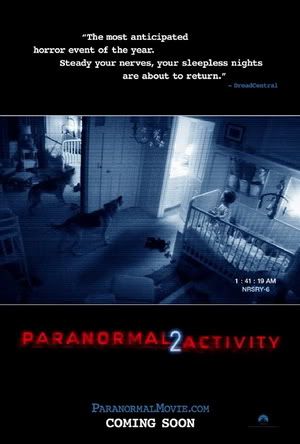
Paranormal Activity 2

Film: Paranormal Activity 2 (2010)
Dir: Tod Williams
Rating: **1/2 out of 5 stars


In 2007’s Paranormal Activity, Katie Featherstone and her boyfriend Micah were terrorized by an aggressive entity in their home. Katie spoke of her and her sister being tormented by a dark figure as children, too. In Paranormal Activity 2, Katie’s sister, now an adult with a newborn baby, is also being harassed by something evil. It begins with loud bangs and slamming doors but soon progresses into something much more sinister as the evil being takes a special interest in the baby boy. As the family struggles to understand what is happening to them, security cameras document the so-called “true” events as they happen.

Much like the first movie, the pacing is incredibly slow for at least the first half of the film. There is a long build-up where hardly anything creepy happens. Fortunately, there are many characters this time around to keep things more interesting. Watching Katie and Micah alone in the first film got pretty tedious. In the sequel, there is a family of four plus a housekeeper and a dog. As a result, the film moves at a better pace than its predecessor. Furthermore, it looks better – perhaps because most of the shots are from static security cameras (and not Micah’s hand-held camcorder); or perhaps it is the new addition of cinematographer Michael Simmonds, who has worked on other indie favorites like Big Fan and Goodbye Solo.

Paranormal Activity 2 is loyal to its predecessor in mood and style. You would never know the director is different because the movie feels like it picks up right where the first left off. The sequel does add more back-story and explanations, though, which works in its favor. The original film introduced the evil and what it was capable of, while the sequel delves further and explains where it came from and why it terrorized Katie and now her sister. It is nice that the sequel builds upon the first film rather than simply rehashing it.

So is it scary? Sometimes. The first film had scarier moments – albeit few and far between – but the sequel does have two or three genuinely spooky incidents. Unfortunately, some of the better parts in 2 are given away in the trailer. One aspect that does help the film is the inclusion of a baby in peril and a mother powerless to help him. The evil entity often targets the child, making those scenes that much more tense. Also, the film takes on a REC-type quality toward the end that makes for some decent tension. Of course, you would be better off watching REC or its sequel for an entire movie of such tension.

The big problem with both Paranormal Activity films is that the boring stuff outweighs the interesting parts. Both films spend a lot of time showing dull, irrelevant footage. Granted, it is not without reason – the goal is to make the entire film appear as though it was real footage. Real people obviously do dull, irrelevant things much of the time. For a filmgoer, however, it can be tedious. The sequel is a little better than the original because it offers more characters and more exposition. The sequel’s theatrical ending is also better than all three endings from the first film.

This reviewer is not a big fan of either Paranormal Activity film because they rely too much on a gimmick rather than genuine terror. Fans of the original, however, will definitely enjoy this sequel. It is consistent and faithful to its predecessor, and what it adds actually improves upon the first film. Director Tod Williams does a good job imitating the look that Oren Peli established for the first film. The scares may not be as frequent or intense as those of the first film, but there are enough to keep PA fans happy.

Saturday, October 23, 2010

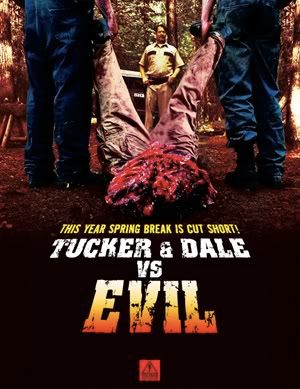
Tucker & Dale vs. Evil

Film: Tucker & Dale vs. Evil (2010)
Dir: Eli Craig
Rating: ****1/2 out of 5 stars


Horror-comedies were big in the 1980s, but sort of dwindled in the 1990s. In 2004, Edgar Wright’s Shaun of the Dead revitalized the sub-genre, and ever since, there have been dozens and dozens of them released. Some are fantastic, but many don’t quite get it. A great horror-comedy requires the right balance of dark humor and a sincere love of the genre. A horror fan can easily distinguish between a hollow spoof and a true horror-comedy. Fortunately, Eli Craig’s Tucker & Dale vs. Evil is of the latter variety, with solid performances, hilarious situational humor, and definite respect for horror.

Tucker (Alan Tudyk) and Dale (Tyler Labine) are two ordinary redneck friends who just bought their own vacation home in the backwoods. Tucker is the leader of the duo, while Dale is a hopeless romantic with low self-esteem. While fixing up their cabin in the woods, they repeatedly encounter a group of college kids on break. Dale’s unsuccessful attempt at talking to a pretty girl sets off a chain of misunderstandings wherein the students become convinced that the two rednecks are psycho killers. As the college kids decide to go after their would-be killers, Dale and Tucker fear for their own lives.

The concept alone of Tucker & Dale vs. Evil is fantastic. It recalls mistaken-identity screwball comedies of the 1930s and 1940s, only it is also infused with everything horror fans love about the genre. It is a hilarious parody of massacre-style flicks (i.e. The Texas Chainsaw Massacre) where the killers are typically rednecks who look just like Tucker and Dale. But these good ol’ boys just want to fish, drink beer, and enjoy their vacation in peace. Meanwhile, the college kids really believe they are being picked off by hillbillies because they are too scared, too dumb, and watch too many horror movies to just shut up and listen.

Tudyk and Labine are both fantastic in their titular roles. They have great buddy chemistry and comedic timing. Some of the actors playing the college kids are also good, particularly Jesse Moss who thinks he is Rambo but looks like Tom Cruise in a popped collar. Even though misunderstanding and miscommunication are comedy staples that have been beaten to death, these qualities are actually really funny here. This is situational comedy at its finest. As a horror flick, Tucker & Dale is not bad either. It racks up quite a body count and delivers some fun gore scenes. Horror fans will also love all the inside references to the genre and its conventions.

At first glance, Eli Craig’s filmography doesn’t inspire confidence with titles like Space Cowboys and The Rage: Carrie 2, but fortunately he only acted in those. As a director, on the other hand, the man has a real future. This movie proves he has the skills to helm either a horror or a comedy with ease - or perhaps another horror-comedy if we’re lucky. There have been tons of horror-comedies released over the last few years, and while some are great, most lack this perfect pacing and wit. Severance was pretty good and parodied the same massacre-horror sub-genre, but Tucker & Dale is better all-around.

Many films have claimed to be "the next Shaun of the Dead" or some variation there of. In the case of Tucker & Dale vs. Evil, it is actually true. Like that movie, this one has lovable characters, lots of blood, and laugh-out-loud humor. This is definitely one of the best horror-comedies of the last decade. The only thing that could have been improved is the film’s title – the “vs. Evil” part misrepresents what the movie is about. The plot is far more clever than the title implies. Of course this is a petty complaint – the film is fantastic. Hopefully it will rightfully achieve the same cult status that Shaun did and keep the horror-comedy genre kicking for a few more years.

Tuesday, October 19, 2010

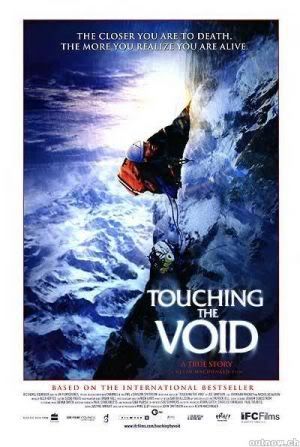
Touching the Void

Film: Touching the Void (2003)
Dir: Kevin Macdonald
Rating: ***** out of 5 stars


True-life survival stories are always captivating. A lazy director could simply make a by-the-books documentary and still produce a tear-jerker. When Kevin Macdonald made Touching the Void, however, he constructed an amazing film using tense re-enactments, survivor interviews, and gorgeous cinematography. Prior to seeing this film, I knew the story of mountaineer Joe Simpson’s brush with death in the Andes, and it was interesting and inspiring. But this movie brings it to life with such intensity and emotion that it had me in tears within the first 25 minutes.

In 1985, two young British mountaineers Joe Simpson and Simon Yates dared to ascend the Siula Grande, a mountain in the Peruvian Andes that had never been successfully climbed. Amazingly, they make it 20,000+ feet up the mountain despite treacherous snow conditions. In a completely isolated part of Peru, thousands of feet up on a dangerous peak, the unthinkable happens – Joe breaks his leg. What follows is a series of unbelievable events as Simon risks his own life to save his friend, and Joe endures an unimaginable ordeal to stay alive. To say anything more would spoil 1.5 hours of beautiful, intense, heart-wrenching storytelling - and it’s all true.

Between interviews with the real Joe and Simon, there are replications of the events using actors and/or stuntmen. These scenes dominate the film, making it more of an action-drama than a traditional documentary. They are also the most realistic re-enactments I have ever seen. It feels like you are really there, watching the situation as it unfolds. These actors look like they are truly going through everything Joe and Simon did. The re-enactments are shot on a large mountain that easily doubles for Siula Grande. Many times, I found myself wondering, “How did they do that?!”at these amazing actors/stuntmen. It is very easy to forget this is not happening live.

Macdonald utilizes sound brilliantly to create tension and fear. Cracking ice, howling wind, and falling snow make it so the viewer can practically feel the frostbite. The music is also a huge part of why the film is so tense and occasionally horrifying. With hardly any dialogue, the music really carries the re-enactment portions of the film. The snowy landscapes and cinematography are breath-taking. We see everything from the epic span of the mountain to the tiniest details in the ice. I wish I could see Void in IMAX as it would be ideal for that medium.

Aside from the great filmmaking, this is just one fantastic story. It has so many amazing twists and turns that it’s hard to believe that it all really happened to someone. Not only is it your classic tale of survival against all odds, but it’s a moving story about friendship. What Simon did for his friend is courageous and few others would do the same. Furthermore, seeing the real Joe and Simon telling their story is great. They are both charismatic men with great personalities and they tell their story with complete honesty – even when it’s unflattering. The way Joe describes his ordeal is often so poetic and beautiful. I have not read his book on which this film is based, but having watched this, I have no doubt it must be a great read.

Touching the Void is a perfect transition between Kevin Macdonald’s early documentaries and his later narrative features (i.e., The Last King of Scotland) because it has the best aspects of each. This unique docu-drama style has the feel-good inspiration of a documentary with the thrills of a big-budget action flick. It grabs the viewer right from the start and its grip only gets tighter with each passing moment. Macdonald’s brilliant combination of two filmmaking styles, in addition to his solid skills as a director, has created an unforgettable testament to the power of friendship and to the strength of the human spirit.

Monday, October 18, 2010

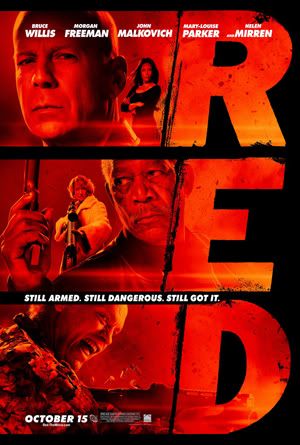
RED

Film: RED (2010)
Dir: Robert Schwentke
Rating: ***1/2 out of 5 stars


RED is based on Warren Ellis’s graphic novel of the same name. The title stands for Retired Extremely Dangerous, which is a codename for the lead characters – all older, former operatives. The concept of this film did not exactly lure me in. It sounded like another in a series of old-guys-doing-young-people-things movies, like Wild Hogs or Space Cowboys. Yawn. As it turns out, I was very wrong. The movie is badass and occasionally hilarious. It does not hurt that it is full of great actors, too. In short, this is the epitome of a fun popcorn flick.

Bruce Willis plays Frank Moses, a retired CIA agent trying to lead a normal, quiet life. The most exciting part of his life these days is flirting on the phone with lonely pensions clerk Sarah (Mary-Louise Parker). Then his idyllic life is interrupted by a team of black-ops who want him dead. Frank hits the road with an unwilling Sarah and seeks out the help of some old friends. Among the recruits are Marvin (John Malkovich), a paranoid schizophrenic; Joe (Morgan Freeman), an 80-year-old former black-ops agent; and Victoria (Helen Mirren), a deadly British operative. Together they uncover a contract on their heads and a series of government cover-ups.

I have not read the graphic novel, so I cannot compare the two, but this film adaptation is pure fun. The action is genuinely exciting, albeit over-the-top. The main actors basically play funnier variations of their typical roles – Freeman as the wise old man; Willis as a badass; Malkovich as a nutcase; and Mirren as a tough old broad. I don’t mind because they play the roles so well. These so-called old farts kick some major ass, especially Mirren, who knows how to rock an Uzi. Also, the movie is really funny, largely thanks to Malkovich’s scene-stealing performance. In addition to the great leads, the film is loaded with fun supporting performances from Brian Cox, Karl Urban, Richard Dreyfuss, James Remar, Julian McMahon, and Ernest Borgnine.

RED is one of many graphic novel adaptations to come out this year. While the others generally disappointed me (Kick-Ass; The Losers), this one completely exceeded my expectations. Do not make any assumptions about the film based on its title, cast, concept, or even trailer. Just go see it. It won’t be winning any Oscars come February, but if you want to have some brainless fun, this is your movie.

Sunday, October 17, 2010

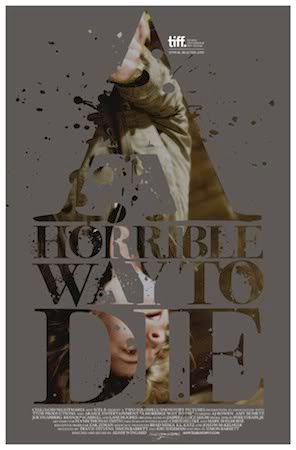
A Horrible Way to Die

Film: A Horrible Way to Die (2010)
Dir: Adam Wingard
Rating: *** out of 5 stars


A Horrible Way to Die is the latest feature from indie horror director Adam Wingard. It is not a well-known title yet, but it has been drawing a lot of attention at recent film festivals, including Fantastic Fest where the writer and lead actors won a few awards. The film was made on a shoestring budget but that fact does not distract from its good writing, fine performances, and even some solid gore. Unfortunately, frantic camerawork does heavily distract from the good parts and therefore drags the movie down a bit.

Sarah (Amy Seimetz) is a recovering alcoholic with a dark past. After moving to a new town, she joins AA in hopes of beating her problem and starting a new life. Although reluctant to begin a relationship, she agrees to go on a date with a fellow AA member, Kevin (Joe Swanberg). As the two grow closer, Sarah knows that she must tell him her dark secret, that her ex-boyfriend is convicted serial killer Garrick Turrell (AJ Bowen). Making matters worse, Turrell just escaped from prison with his sights set on Sarah, killing anyone who gets in his way.

Screenwriter Simon Barrett has constructed a simple yet effective script. The concept and the characters are well-written. The tension is slow-to-build in places, but the story picks up toward the end and wraps up nicely. Complementing Barrett’s writing are some talented actors. Indie darling Amy Seimetz is very good in the lead role. Sarah is 100% victim – she is not a strong female figure but we get the impression that perhaps she once was. Alcoholism and Turrell have seemingly made her this way – a ruined woman. Seimetz is an ideal match for the part of this woman emotionally battered by her own demons.

However, it is AJ Bowen who really steals the movie as Garrick. Like many serial killers, Turrell is a man of few words, but complex nonetheless. In Bowen’s face, you can see how the character struggles with his urge to kill – how he genuinely means it when he promises not to hurt his victims right before he murders them. The kill scenes are brutal and bloody – a stark contrast against the flashbacks in which Garrick is tender with his then-girlfriend Sarah. Bowen delivers the perfect blend of intensity and sympathy for the role.

Wingard’s storytelling style is effective, as the film flows well, but his visual choices are questionable. Most shots are out of focus, shake wildly, or veer away from anything of relevance (actors, scenery, etc.). This kind of nauseating camerawork does nothing to help the film. Presumably, Wingard’s intention was to symbolize the frantic nature of each scene – a filmmaking choice that lacks originality. Whatever his goal, it looks like his cameraman has some combination of ADD and epilepsy. This is not pleasant to watch, nor does it instill a sense of tension or uneasiness. It just comes across as annoying to the viewer. In many shots, the lighting and set design are great – it is a shame to have those aspects hidden by a runaway camera.

The concept of A Horrible Way to Die is as old as the horror genre itself – a girl being stalked by a killer. But this is not a typical cat-and-mouse story, as it deals more with internal menaces such as dark secrets, addiction, and denial. The film makes good use of its meager budget, and despite some eye-straining camerawork, is an interesting little thriller worth checking out.

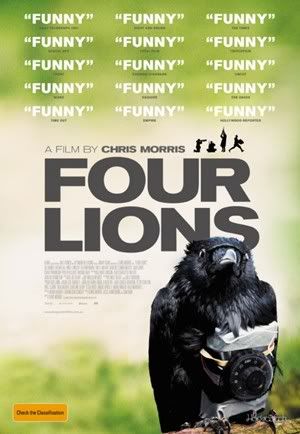
Four Lions

Film: Four Lions (2010)
Dir: Chris Morris
Rating: **** out of 5 stars


Cinema’s greatest satires have often been made while the issue at hand was still fresh and audiences were sensitive to it. Just as Dr. Strangelove satirized the Cold War as it was going on, Four Lions parodies Islamic extremists, as well as the Western world’s prejudice against Muslims. The timing could not be better, especially with the recent controversy over a mosque being built near Ground Zero. This is not a film for easily offended people – it may be politically accurate but it is not politically correct. The film does not pull its punches against either side, and it manages to make you laugh at things that would normally make you shudder. There is also a surprising amount of emotion peeking through the dark satire.

Omar (Riz Ahmed) is a British-born man of the Muslim faith who runs a small jihadist cell in London. He believes that Muslims around the world are being oppressed, and to help the problem he must become a soldier or even a martyr. After a failed attempt at joining a terrorist training camp, Omar plots to send a message by staging a bombing in London. This proves to be no easy task as Omar’s jihadist mates are morons, each having a different idea about how to fight their non-Muslim oppressors. Among them is Barry (Nigel Lindsay), an angry white Islamic convert; Waj (Kayvan Novak), a dim-witted follower; Fessal (Adeel Akhtar), a skittish bomb-maker; and Hassan (Arsher Ali), a young wannabe terrorist/rapper.

The dark humor in Four Lions is consistent and effective. Some of it might make you feel guilty for laughing, but you will laugh nevertheless. Each character is hilarious in his own way, plus the inherent satire is ever-present. Whether you are giggling at the idiotic antics of these men, or smirking at the socio-political irony throughout, you will not be bored. Upon first viewing, I missed quite a few jokes because the characters’ British accents are thick and they talk so fast, but I still laughed loud and often. I cannot wait to watch it again – perhaps with the English subtitles on next time.

Although you may be laughing at these failed wannabe terrorists, the film does not insult the Muslim faith, nor does it justify American and British treatment of Muslims. Each character is likable and sympathetic. You can tell they truly believe what they are doing is right. Still, the movie exposes the flaws in extremists’ logic via satire. It also explores the way non-violent Muslims are often discriminated against because of their extremist counterparts. The film is surprisingly touching and undeniably clever. The script was written by the same guys who penned In the Loop, the hilarious political farce from last year. The two films have a lot in common in terms of humor, mood, and how completely spot-on the satire is.

The screenwriters are not the only ones to thank for the funny, likable anti-heroes – all the actors involved are great. They are never two-dimensional stereotypes or cheap gags. You cannot help but care about these characters, even though your first instinct is to hate them, especially if you are an American. Ahmed and Novak give especially sympathetic performances, as their characters are the least influenced by narcissism or selfishness. Omar genuinely believes in what he is doing, and Waj just wants to be like his friend.

Four Lions is a stellar feature film debut for director Chris Morris. Terrorism is not an easy topic to tackle, but Morris and the screenwriters handle it with tact and fairness, while never sacrificing honesty or humor. The film is powerful, hilarious, moving, and an absolute must-see.

Monday, October 11, 2010

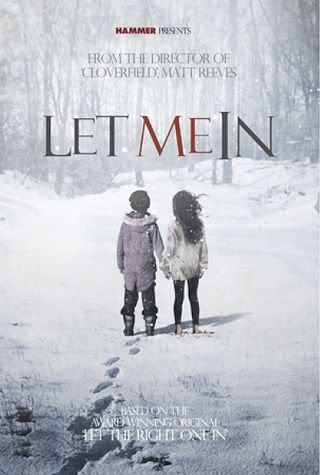
Let Me In

Film: Let Me In (2010)
Dir: Matt Reeves
Rating: **** out of 5 stars


Check out my review of Let Me In at The Horror Channel:

http://www.xomba.com/let_me_review

Please comment and discuss!

Sunday, October 10, 2010

Joint Security Area

Film: Joint Security Area (2000)
Dir: Chan-wook Park
Rating: **** out of 5 stars


Following World War II, Japan lost control of the Korean peninsula, and the country was divided between the Communist north and the Capitalist south. In the early 1950s, constant border skirmishes and raids escalated into a full-blown war. The United States came to the aid of South Korea while the Soviet Union backed the North. That war ended, but today there still exists a buffer zone between the North and the South known as the Korean demilitarized zone (DMZ) where diplomatic engagements take place.

The “Joint Security Area” or JSA refers to the only part of the DMZ where forces from each side stand face-to-face. Armed guards from each region patrol the border with mutual paranoia and distrust for their enemy neighbor. Chan-wook Park’s Joint Security Area tells the story of Korean soldiers reluctantly caught up in the conflict.

In the film, two North Korean soldiers are shot and killed in the JSA and a South Korean soldier is held as a suspect. The South claims he was kidnapped and forced to shoot his way out; the North claims he infiltrated their camp and committed murder. Swedish and Swiss officers from the Neutral Nations Supervisory Commission intervene to investigate the incident and hopefully alleviate the North-South tensions before a serious conflict erupts. The investigation is led by a Swiss-Korean woman, Major Jean (Young Ae Lee), who finds evidence to suggest a possible cover-up among the survivors of the shooting.

The film opens with the investigation, and through flashbacks, slowly reveals the series of events that led up to the incident. Nothing is as it initially seemed when the story reveals an unlikely situation. The script is well-structured and moving. It brings up issues of loyalty, patriotism, and defiance. Furthermore, the film is full of fascinating historical information about the decades-long Korean conflict. World history buffs should find it very interesting.

Young Ae Lee gives a solid performance as an investigator trying to find the truth against an onslaught of lies and cover-ups. It is nice to see a Korean actress in a non-romantic role. Kang-ho Song, a staple of Chan-wook Park films, portrays a North Korean sergeant, while Byung-hun Lee plays the South Korean soldier being investigated. Both actors are great but Song has a quality about him that makes him unforgettable in every film he does. His acting often transcends a need for subtitles because his face can say so much without speaking.

To those who have ever watched a Chan-wook Park film, it should come as no surprise that the directing of Joint Security Area is tight and skillful. The visuals are not as bold or eccentric as Park’s more recent films, but such style would not be appropriate to the subject matter anyway. JSA is based on a real, ongoing Korean conflict and tells an emotional tale, so no flashiness is needed here.

While it may not be as badass as Oldboy or Thirst, the pacing is steady and the drama is intense. The scenes involving the investigation are not as tense and interesting as the flashbacks, but fortunately after the first 30 minutes, those scenes are few and far-between. Good storytelling and fine performances make JSA a breeze to watch. It is recommended viewing for fans of Park or war dramas, and world history/current events enthusiasts.

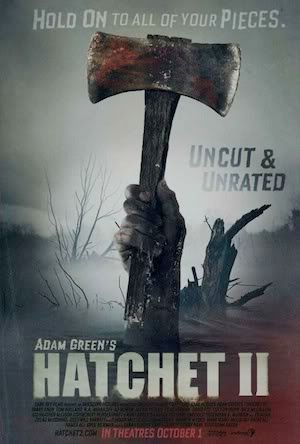
Hatchet II

Film: Hatchet II (2010)
Dir: Adam Green
Rating *** out of 5 stars


Check out my review of Hatchet II at The Horror Channel:

http://www.xomba.com/hatchet_ii_review

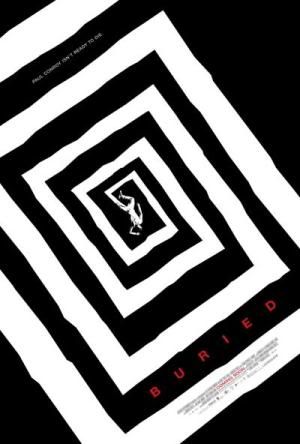
Buried

Film: Buried (2010)
Dir: Rodrigo Cortés
Rating: **** out of 5 stars


Check out my review of Buried at The Horror Channel:

http://www.xomba.com/buried_review

Tuesday, October 05, 2010

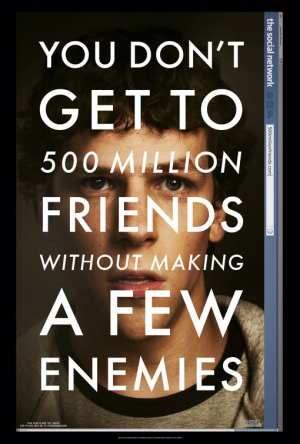
The Social Network

Film: The Social Network (2010)
Dir: David Fincher
Rating: ****1/2 out of 5 stars


Ever since it was announced that David Fincher was making The Social Network, there have been skeptics who have basically dubbed it “Facebook: The Movie.” In reality, this is not a film about Facebook. It is a classic story about ambition, jealousy, and regret. The birth of the social networking site may be used as a template to tell this story, but the film’s themes are as old as time itself and will continue to find a captivated audience long after Facebook is forgotten.

In his early years at Harvard University, Mark Zuckerberg (Jesse Eisenberg) was already launching networking websites by hacking into school databases. His antics made him so notorious on-campus that he was asked by elite Harvard athletes, the Winklevoss twins, to help with a Harvard-exclusive networking site. Believing he could make something better, Mark creates Facebook instead with help from his best friend, Eduardo (Andrew Garfield).

As the site becomes wildly popular and adds new schools, it draws the attention of Napster founder and playboy, Sean Parker (Justin Timberlake), who encourages Mark to move to California and live the high-life in Silicon Valley. In the process of becoming the world’s youngest billionaire and a geek-chic rockstar, Mark loses a few friends and becomes the target of multiple lawsuits, including one from the Winklevoss twins for intellectual property theft.

The Social Network does not set out to portray an idea-stealing jerk, nor an imperfect genius. The character, much like the truth, falls somewhere in-between. Mark is reminiscent of Charles Foster Kane of Citizen Kane - both ambitious men who seek fame and fortune, but it never makes them happy. Despite all their success, they cannot let go of a single detail from their past. Kane’s hang-up was his lost youth (“Rosebud…”), but for Mark it was a girl – Erica Albright. His drive to succeed is spurred by his attempts to get her back, or by his jealousy of other people who have what he never could. Also like in Kane, the film’s non-linear narrative is divided between young Mark’s rise to success and the lonely man he turns into (as shown during lawsuit depositions).

No doubt many viewers will get hung up on whether or not all the events and conversations in this movie really happened. The truth is, it does not matter – this film works just as well even if it was 100% fictional. Still, screenwriter Aaron Sorkin is very good about being unbiased and not suggesting that anyone is lying or plagiarizing. For instance, the Winklevoss twins could have easily come across as douchey jocks, but the film goes out of its way to defend their honor. Even Mark, for all his flaws, is sympathetic and often regretful of his poor decisions. And even if the real Mark Zuckerberg is nothing like the one portrayed in this movie, so what? Who can fault Sorkin for creating a fascinating character study? A great, fake story beats a crappy, true one any day.

The entire cast of this movie is fantastic. Jesse Eisenberg proves his acting chops as Mark Zuckerberg. Gone is that awkward, funny guy from Zombieland. In addition to his sharp wit and brains, Mark is brutally honest and condescending, and Eisenberg disappears into the role. On the opposite end of the personality spectrum is Mark’s best friend Eduardo, portrayed by Andrew Garfield. After being quite impressed with Garfield’s performance here, I am far less worried about his casting as Spider-Man in the forthcoming reboot.

Armie Hammer is also very good in Social Network, playing both of the identical Winklehoss twins himself. Each of the brothers was so different in personality that you can tell them apart despite their identical faces. Justin Timberlake is pretty good, too, and his Lady MacBeth-esque character is a great aspect of the story.

The soundtrack is another important aspect that makes The Social Network what it is. The music, composed by Trent Reznor of Nine Inch Nails, is exciting, tense, and haunting in all the right places. Not only does the soundtrack kick ass, but it is very appropriate to have this movie scored by an artist from the same generation as Facebook.

Just like Citizen Kane is still considered one of the greatest films ever made, The Social Network is a movie that transcends the time period in which it was made. The character types and themes are universal, and while Facebook may be an icon of this generation, the movie will always be relevant and engaging.

Monday, October 04, 2010

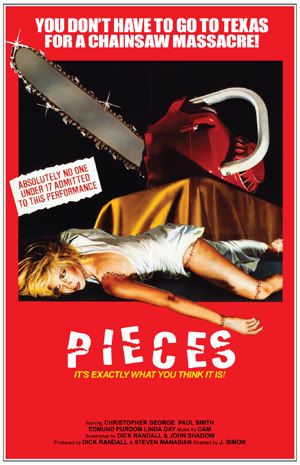
20 Greatest Horror Movie Taglines

Please check out my lists of the 20 greatest horror movie taglines on The Horror Channel:


Part 1 (20-11)

Part 2 (10-1)

Please comment and discuss :)