Showing posts with label violence. Show all posts

Friday, November 05, 2010

The Girl with the Dragon Tattoo

Film: The Girl with the Dragon Tattoo (2009)
Dir: Niels Arden Oplev
Rating: *** out of 5 stars
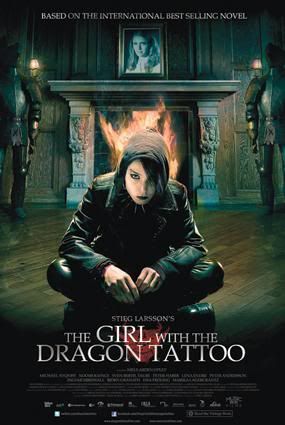


Not since Let the Right One In has a Swedish film gained so much attention States-side as The Girl with the Dragon Tattoo. Based on Stieg Larsson’s popular novel of the same name, the film is the first installment of the Millennium Trilogy, which also includes the sequels, The Girl Who Played with Fire and The Girl Who Kicked the Hornet’s Nest. The first film is a pretty good murder mystery once it gets moving, but unfortunately it is exceeded by its own hype.

In the movie, disgraced journalist Mikael Blomkvist (Michael Nyqvist) is asked by wealthy industrialist Henrik Vanger to investigate the unsolved disappearance of his teenage niece Harriet roughly 40 years ago. As Henrik nears the end of his life, he yearns to finally put an end to the mystery that has tormented him for four decades. Mikael agrees to take the case and moves into the Vanger family’s island home.

Meanwhile, an emotionally-scarred young hacker named Lisbeth Salander (Noomi Rapace) tracks Mikael out of professional and personal interest. Her prying leads her to uncover clues in the Harriet Vanger case, so she joins Mikael in his investigation. Together they open the lid on some dark family history, and as they get closer to the truth, their own lives are put in danger.

The script, written by Nikolaj Arcel and Rasmus Heisterberg, is a bit slow at first. The film really picks up once the two lead characters get together and the investigation starts to get interesting. Prior to that, there is a lot of background story provided for Lisbeth, which occupies much of the first hour. Still, the visual history makes her that much more of an intriguing character study. She carries a lot of emotional baggage, and some of her traumatic experiences explain her interest in Harriet’s disappearance. One piece of her history that is underrepresented in the film is the titular dragon tattoo, which is shown once and never addressed again. Furthermore, Lisbeth is more a sidekick than a centerpiece of the story, so why is her tattoo so important that it made the title? I suspect the novel touched on its significance, but the movie does not, which is perplexing.

Once the exciting portion gets underway, Dragon Tattoo is a pretty effective who-dun-it thriller. There are many potential suspects, misleading clues, and disturbing motives. The story involves religious fanaticism, cult rituals, and Nazis – all wrapped up in a taut, realistic murder mystery. The ending is a bit abrupt and all-too-convenient, but it is seemingly only as such because of the planned sequels. As Lisbeth, Noomi Rapace has garnered a lot of attention and deservedly so, as she is quite good. Michael Nyqvist, on the other hand, has not been quite as noticed by American audiences but he is also very good in the film.

Of course there is already an American remake of The Girl with the Dragon Tattoo in the works. Fortunately, that remake will have David Fincher at the helm, so there is a very real possibility that it will be better than the Oplev’s film. Frankly, the original Dragon Tattoo is overhyped. It is an enjoyable movie, but not nearly as brilliant as some self-proclaimed art house film buffs seem to think it is. I have only seen the first installment so far, but at this point, I am more interested in seeing Fincher’s re-boot than the two Swedish sequels.

Friday, October 29, 2010

Bloody Sunday

Film: Bloody Sunday (2002)
Dir: Paul Greengrass
Rating: **** out of 5 stars


On January 30, 1972, a peaceful march was planned in the Irish town of Derry. It was one of many events staged by residents of Northern Ireland to protest English oppression. A British paratrooper regiment was put in place with orders to quell a potential uprising and make arrests. During the demonstration, a few rebellious teenagers threw stones at the soldiers, resulting in a small riot. During the confusion, the British Army command center received reports of a possible IRA sniper in the area. The paratroopers subsequently entered the Bogside area and began firing into the crowd of civilians. Thirteen Irish were killed and fourteen wounded. All the victims were unarmed and many were shot in the back while fleeing. The subsequent inquiry by the British defended the actions of the paratroopers, justifying the shootings as self-defense.

The incident has been forever immortalized as “Bloody Sunday.” It was a devastating tragedy, made worse by the fact that justice has yet to be served for the victims. British writer/director Paul Greengrass captures the incident with striking fidelity. Shot on a hand-held camera, the film feels almost suffocating, like watching a horror movie. The story is divided between three perspectives – the Army command center; the paratroopers; and the protesters. This is a very effective design and it feels less biased. In the film, not all British are portrayed as monsters, nor are all Irish portrayed as saints. The paratroopers believed they were up against a real enemy, and like the protesters, they too were scared. This honesty makes the film feel that much more real.

Leading the march was politician Ivan Cooper, who is portrayed by James Nesbitt in Bloody Sunday. Cooper, a major player in the Irish civil rights movement, believed in non-violent protest and very much wanted to avoid a conflict that Sunday afternoon. The emotional impact of the “Bogside massacre” (as it is also known) is visualized through Cooper in the film. He is the walking embodiment of Irish liberation, and the January 30th incident takes a crushing toll not only on him personally but on the rights movement itself. Furthermore, the actions of the British only served to galvanize the Irish Republican Army, with whom he strongly disagreed. As Cooper, Nesbitt is a very likable moral center, and when the weight of the situation is upon him, his eyes recall the intensity of a young Jack Nicholson.

Writer/director Paul Greengrass delivers a powerful script and his usual gritty visual style. His script focuses on some characters closely – including Cooper; one of the shooting victims; and a reluctant British soldier – in order to help the viewer become emotionally invested in these people and not get swept away by the scale of the tragedy. The hand-held camerawork is very effective at creating tension and fear, putting the viewer right there on the streets of Derry. However, Greengrass does have a tendency to cut excessively which can be off-putting. The film skips around and scenes often fade to black before they feel complete. Granted, the effect gives the film the look of actual footage that has been haphazardly spliced together, but such hyperactive editing is also a bit distracting to the viewer.

The events of that day and what they represent still resonate today with Irish and non-Irish alike. Countless artists and musicians, including U2 and John Lennon, have paid tribute to the victims. Bloody Sunday too is a fitting artistic tribute to a piece of history that must never be forgotten. In June of 2010, the British prime minister apologized for the shootings on Bloody Sunday following a report that decreed the paratroopers were not justified and that innocent, unarmed civilians were gunned down that day. Perhaps artists’ renderings such as this film have bolstered support for the cause and are now hopefully bringing peace to the families left behind.

Wednesday, October 27, 2010

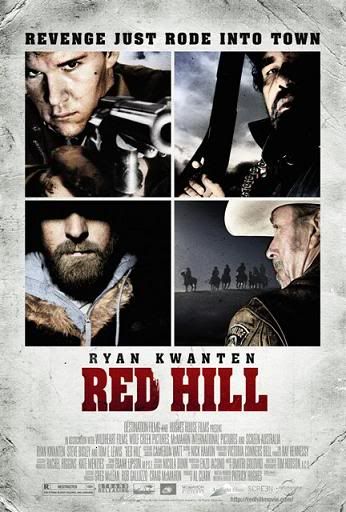
Red Hill

Film: Red Hill (2010)
Dir: Patrick Hughes
Rating: **** out of 5 stars


The western film is a genre rarely seen anymore. Gone are the days of John Wayne and duels at high noon. This decline is probably due to audiences' general lack of interest in period pieces. But Westerns do not necessarily have to take place in the Old West. A film need only encompass the themes of a western to fit the genre, though a rural setting does help. Australia is an ideal location to set a modern western because much of the country is still undeveloped, sparsely populated, and even dangerous. The “wild wild west” of yesteryear is now the great Australian outback. Patrick Hughes must have recognized this when he made Red Hill, a cleverly-written and action-packed western set in a small Australian town.

Australian police constable Shane Cooper (Ryan Kwanten) moves from the big city to a (literally) one-horse town called Red Hill. Here he hopes to find peace and quiet for him and his pregnant wife. Cooper is immediately disliked by his boss, gruff Chief Inspector “Old Bill” for being a doe-eyed city slicker with an aversion to violence. Cooper is barely in town for a day when the news breaks of an explosion at a nearby prison. One particularly dangerous convict is reported to have escaped – Jimmy Conway, who was put away for life by Old Bill. The locals gather up their guns and brace for a visit from Jimmy who, as Bill puts it, “is coming back to town and bringing Hell with him.” Cooper finds himself in the middle of a firestorm as Jimmy indeed wreaks havoc on the small town and unveils some of its dark history along the way.

Writer/director Patrick Hughes brings back revenge westerns in a big way with his feature film debut. The movie recalls gritty classics by Sergio Leone and Sam Peckinpah. Hughes’ story hits all the genres familiar clichés but in the best possible way: we get the dark stranger riding into town; the honorable protagonist (appropriately named Shane) defending truth and justice; and a town with so many secrets it is practically a character unto itself. These are old archetypes and the story is a bit predictable, but the script is tightly written and steeped in Australian history.

The film subtly addresses issues such as the impact of industrialization on Australian natural resources and the treatment of the native Aborigines. The script has a surprising amount of depth for an action-packed western. There is even a strong visual metaphor in the film that can easily be misunderstood if one does not consider the deeper themes of the story. It is a bit heavy-handed, and the film probably could have omitted it altogether, but Hughes had good intentions.

Kwanten is best known for playing resident heartthrob Jason Stackhouse on HBO’s “True Blood.” The Aussie actor is one of the best parts of that television show, completely disappearing into the role of the Southern bad boy. In Red Hill, he further proves his acting chops as wet-behind-the-ears Constable Cooper. He fulfills the familiar role of an honest lawman thrust into strange territory up against an unstoppable menace. Kwanten makes a good action star without sacrificing charm and sensitivity. Cooper prefers diplomacy to a bullet, much to the chagrin of his new co-workers, but they underestimate his ability to lay down the law.

As Jimmy Conway, Tommy Lewis (The Proposition) is one frightening, badass villain. With a scarred face and a black leather duster, he rides into Red Hill looking for the men who put him behind bars, prepared to strike down anyone who stands in his way. Another great performance comes from Steve Bisley (Mad Max) as Old Bill. As the local authority with whom Cooper butts heads, Bisley gets to be something of a villain himself. He is crotchety veteran of the force who is set in his old ways, which can be a dangerous thing for a fish-out-of-water like Cooper.

Red Hill has some stunning cinematography courtesy of Tim Hudson. The wild Australian landscape makes the perfect setting for a violent western, and Hudson knows how to shoot it beautifully. Dmitri Golovko’s score also sets the mood just right for a bloody clash down under.

The film is produced by Wolf Creek director Greg Mclean, who is often credited with revitalizing Australian genre films. Perhaps that distinction would be better reserved for Patrick Hughes. While Mclean’s horror movie attempted (poorly) to revisit the Ozpolitation trend of the 1970s/1980s, Hughes’ western is helping to put Australia back on the map as a source for solid cinema. The writer/director has a strong future ahead of him and hopefully there is the truth to the rumor that Red Hill is only part one of a thematic trilogy.

Monday, October 18, 2010

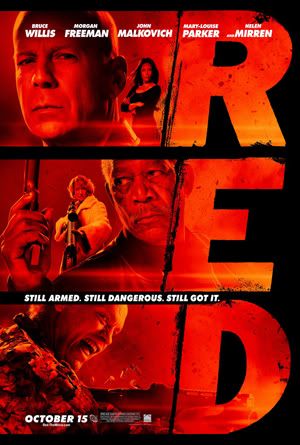
RED

Film: RED (2010)
Dir: Robert Schwentke
Rating: ***1/2 out of 5 stars


RED is based on Warren Ellis’s graphic novel of the same name. The title stands for Retired Extremely Dangerous, which is a codename for the lead characters – all older, former operatives. The concept of this film did not exactly lure me in. It sounded like another in a series of old-guys-doing-young-people-things movies, like Wild Hogs or Space Cowboys. Yawn. As it turns out, I was very wrong. The movie is badass and occasionally hilarious. It does not hurt that it is full of great actors, too. In short, this is the epitome of a fun popcorn flick.

Bruce Willis plays Frank Moses, a retired CIA agent trying to lead a normal, quiet life. The most exciting part of his life these days is flirting on the phone with lonely pensions clerk Sarah (Mary-Louise Parker). Then his idyllic life is interrupted by a team of black-ops who want him dead. Frank hits the road with an unwilling Sarah and seeks out the help of some old friends. Among the recruits are Marvin (John Malkovich), a paranoid schizophrenic; Joe (Morgan Freeman), an 80-year-old former black-ops agent; and Victoria (Helen Mirren), a deadly British operative. Together they uncover a contract on their heads and a series of government cover-ups.

I have not read the graphic novel, so I cannot compare the two, but this film adaptation is pure fun. The action is genuinely exciting, albeit over-the-top. The main actors basically play funnier variations of their typical roles – Freeman as the wise old man; Willis as a badass; Malkovich as a nutcase; and Mirren as a tough old broad. I don’t mind because they play the roles so well. These so-called old farts kick some major ass, especially Mirren, who knows how to rock an Uzi. Also, the movie is really funny, largely thanks to Malkovich’s scene-stealing performance. In addition to the great leads, the film is loaded with fun supporting performances from Brian Cox, Karl Urban, Richard Dreyfuss, James Remar, Julian McMahon, and Ernest Borgnine.

RED is one of many graphic novel adaptations to come out this year. While the others generally disappointed me (Kick-Ass; The Losers), this one completely exceeded my expectations. Do not make any assumptions about the film based on its title, cast, concept, or even trailer. Just go see it. It won’t be winning any Oscars come February, but if you want to have some brainless fun, this is your movie.

Sunday, October 17, 2010

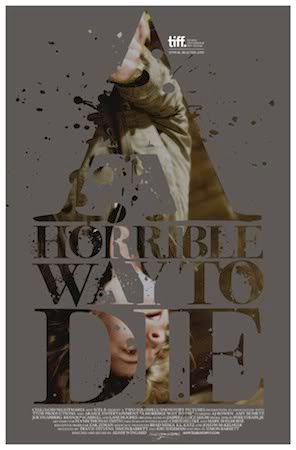
A Horrible Way to Die

Film: A Horrible Way to Die (2010)
Dir: Adam Wingard
Rating: *** out of 5 stars


A Horrible Way to Die is the latest feature from indie horror director Adam Wingard. It is not a well-known title yet, but it has been drawing a lot of attention at recent film festivals, including Fantastic Fest where the writer and lead actors won a few awards. The film was made on a shoestring budget but that fact does not distract from its good writing, fine performances, and even some solid gore. Unfortunately, frantic camerawork does heavily distract from the good parts and therefore drags the movie down a bit.

Sarah (Amy Seimetz) is a recovering alcoholic with a dark past. After moving to a new town, she joins AA in hopes of beating her problem and starting a new life. Although reluctant to begin a relationship, she agrees to go on a date with a fellow AA member, Kevin (Joe Swanberg). As the two grow closer, Sarah knows that she must tell him her dark secret, that her ex-boyfriend is convicted serial killer Garrick Turrell (AJ Bowen). Making matters worse, Turrell just escaped from prison with his sights set on Sarah, killing anyone who gets in his way.

Screenwriter Simon Barrett has constructed a simple yet effective script. The concept and the characters are well-written. The tension is slow-to-build in places, but the story picks up toward the end and wraps up nicely. Complementing Barrett’s writing are some talented actors. Indie darling Amy Seimetz is very good in the lead role. Sarah is 100% victim – she is not a strong female figure but we get the impression that perhaps she once was. Alcoholism and Turrell have seemingly made her this way – a ruined woman. Seimetz is an ideal match for the part of this woman emotionally battered by her own demons.

However, it is AJ Bowen who really steals the movie as Garrick. Like many serial killers, Turrell is a man of few words, but complex nonetheless. In Bowen’s face, you can see how the character struggles with his urge to kill – how he genuinely means it when he promises not to hurt his victims right before he murders them. The kill scenes are brutal and bloody – a stark contrast against the flashbacks in which Garrick is tender with his then-girlfriend Sarah. Bowen delivers the perfect blend of intensity and sympathy for the role.

Wingard’s storytelling style is effective, as the film flows well, but his visual choices are questionable. Most shots are out of focus, shake wildly, or veer away from anything of relevance (actors, scenery, etc.). This kind of nauseating camerawork does nothing to help the film. Presumably, Wingard’s intention was to symbolize the frantic nature of each scene – a filmmaking choice that lacks originality. Whatever his goal, it looks like his cameraman has some combination of ADD and epilepsy. This is not pleasant to watch, nor does it instill a sense of tension or uneasiness. It just comes across as annoying to the viewer. In many shots, the lighting and set design are great – it is a shame to have those aspects hidden by a runaway camera.

The concept of A Horrible Way to Die is as old as the horror genre itself – a girl being stalked by a killer. But this is not a typical cat-and-mouse story, as it deals more with internal menaces such as dark secrets, addiction, and denial. The film makes good use of its meager budget, and despite some eye-straining camerawork, is an interesting little thriller worth checking out.

Thursday, September 03, 2009

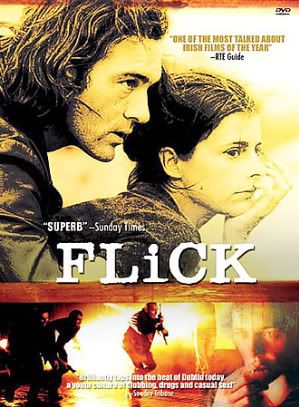
Flick (2000)

Film: Flick (2000)
Dir: Fintan Connolly
Rating: *1/2 out of 5 stars


I watched this low-budget Irish drama for one reason only - David Murray. I have had an interest in the man ever since his tiny, tiny role in Batman Begins. He had one line ("Where are you?!") but it was enough to make me and my boyfriend simultaneously go, "Who IS that guy?" He has a star quality about him, I just had to see more. He was originally cast to play Destro in G.I. Joe: The Rise of Cobra but was ultimately demoted to a smaller role. In Flick, however, Murray is the star. But much like G.I. Joe, this movie freaking sucks.

This is just another film about small-time pushers and what happens when a drug deal goes south. Murray's character - known by his friends as "Flick" - is trying unsuccessfully to escape this lifestyle. He trusts stupid people, gets in too deep, and suffers the consequences. Frankly, we've seen it all before. If you want to watch a good film about the seedy underworld of drug dealers, watch Refn's Pusher trilogy.

From the very beginning, Flick's low production value is distracting. It looks like a cheap Spanish soap opera with fuzzy lenses and focus that goes in and out. The directing is obnoxiously amateur. The dialogue is forced and often pointless, and many of the actors are just terrible, especially the actresses (Isabelle Menke and Catherine Punch). The character development is shit. When the two leads jump into bed after a worthless two-minute conversation, I could only scream, "What?!" The result is a forced, premature, and drawn-out sex scene. The eye candy is its only saving grace.

The whole thing is slow, full of pointless melodrama and scenes where characters simply stare at each other. All this accompanied by corny saxaphone music. Murray is the best part of the movie, as he actually delivers a believable performance. This man deserves better. For the love of St. Patrick, somebody discover him!

Saturday, August 22, 2009

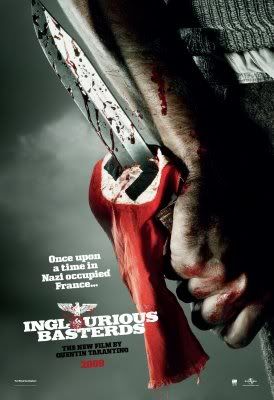
Inglourious Basterds

Film: Inglourious Basterds (2009)
Dir: Quentin Tarantino
Rating: ***** out of 5 stars


After a long streak of great films, I figured Quentin Tarantino had finally begun a downward spiral following the surprisingly flawed Death Proof. The mixed reviews of Inglourious Basterds coming out of Cannes supported that theory. So my expectations were pretty low. As it turns out, I was dead wrong. Basterds is a unique, fun, and mature addition to QT's repertoire.

Basterds is a fictionalized WWII tale set in Nazi-occupied France. Lt. Aldo Raine (Brad Pitt) leads a group of Jewish-Americans (and two German defectors) on a mission with one goal: kill as many Nazis as possible. These "Basterds" and their brutal tactics effectively terrorize the SS. Meanwhile, a young cinema proprietor named Shoshanna (Mélanie Laurent) attracts the attention of a Nazi war hero-turned-actor, who insists on screening his movie at her theatre. What he doesn't know is that Shoshanna - a Jew in hiding - witnessed her family slaughtered by Nazis, and has revenge on her mind. When word of the premiere gets out, the Basterds plan to sabotage the event and hopefully kill a large portion of the attending Third Reich.

Like some of QT's previous films, this one is broken into chapters. This technique is especially appropriate here because the story is more like a fairy tale than a history lesson. It even begins with "Once upon a time...." There are hundreds of films portraying the bleak realities of WWII, but Basterds is not one of them. Frankly, I have seen enough movies about the Jews being tortured, gassed, burned, and buried - it's about time we get to see them kicking Nazi ass! There is only one scene of violence against Jews in this entire film - but a dozen against the SS. And it's awesome. Maybe it never really happened, but who cares? It is very satisfying.

However, one way Basterds is more accurate than most of its predecessors is the fact that the Germans speak German and the French speak French. English is only used when appropriate or explained, and the rest is left to subtitles. Often times, the languages switch back and forth. To accomplish this task, Tarantino hired very talented bilingual actors like Diane Kruger, Michael Fassbender, Daniel Brühl, and Christoph Waltz. All do an amazing job, and give the film a feeling of authenticity. On the American end, Pitt's tongue-in-cheek performance is hilarious.

As much as I love the entire cast, I have to single-out the golden child of this movie - Christoph Waltz. He portrays the charming, scene-stealing Nazi villain, Col. Hans Landa. He provides some of the film's funniest moments, and easily gives the strongest performance. Dare I say, this is the greatest performance Tarantino has ever gotten from any actor. QT said himself he could never have made this movie without Waltz. The former tv actor is one of those brilliant untapped thespians, and I'm so glad Tarantino exposed him to the world. I have no doubts that the 2009 Supporting Actor Oscar is his, especially after winning Cannes' Best Actor prize. It is impossible to watch Basterds and not be captivated by Col. Landa every second he is on screen.

Okay, enough gushing about Christoph. I also must mention the great gore FX courtesy of Greg Nicotero and his crew, and the incredible score by legendary composer Ennio Morricone. All these elements combine into a fantastical war film with the heart of a western. Tarantino's story and dialogue are great, and his self-love is kept to a minimum this time. I have read parts of the original screenplay, and can see where much of his rambling dialogue was cut, thankfully. Contrary to my worries, it is very possible that his films are only getting better.

Thursday, July 16, 2009

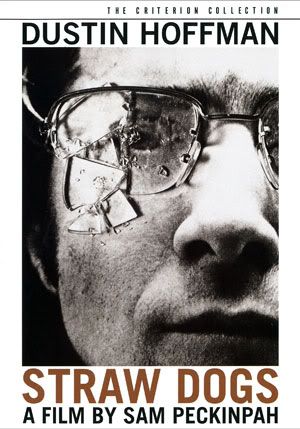
Straw Dogs

Film: Straw Dogs (1971)
Dir: Sam Peckinpah
Rating: **** out of 5 stars


I went into this film with a complete misunderstanding of its plot, and for that I am thankful. On the surface, it looks like a violent drama about rape and revenge, but Peckinpah delivers much more than that. It is truly about masculinity, self-preservation, and dignity. It addresses the lengths to which humans will go to protect what is ours - be it woman, home, or moral integrity.

Dustin Hoffman portrays David Sumner, a physicist who moves to a small English village with his wife Amy in hopes of peace and quiet. While the local handymen gawk at Amy and make her uncomfortable, David prefers not to cause trouble. Gradually, the tense situation escalates as their marriage becomes strained, and the locals become more intrusive. Before long, circumstances force David to take a stand and defend his home. Much violence ensues.

Without giving away too much, I was surprised at the catalyst for Dogs' infamous climax. It was nothing like I had expected, which is great. It forces you to question your own moral integrity on a few levels, whereas I was sorta just expecting an emotionally two-dimensional bloodbath. David's transformation is far more complex than I had imagined. Needless to say, Hoffman is fantastic - completely believable as both weenie and badass. Susan George is also good as Amy (anyone else see a resemblance to Summer Glau?).

For similar fare, check out The Backwoods. It is a weaker, more shallow version of Straw Dogs, but the cast is top-notch.

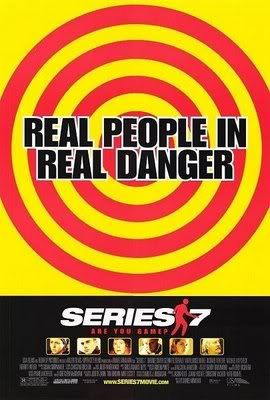
Series 7

Film: Series 7: The Contenders (2001)
Dir: Daniel Minahan
Rating: *** out of 5 stars


Nowadays, the need to satirize reality television is obsolete, since shows like Flavor of Love or I'm a Celebrity, Get Me Out of Here are already a big joke. Furthermore, it's virtually impossible to shock audiences with what reality TV could become when it has already churned out countless shows based on depraved people and immoral behaviors. But back in 2001, when reality television was only just beginning to rear its ugly head, Series 7 caught onto the satire early.

The film is presented as a marathon of reality show episodes from a program called "The Contenders." In its seventh series, six American citizens are randomly chosen by a lottery to participate. They are given a handgun and told they must kill the other contenders. Among the contestants are a teenager, a terminally ill man, and an eight-month-pregnant woman who is the reigning champion due to her complete ruthlessness. Needless to say, this program knows no moral bounds.

The film never strays from the reality television format, giving it an unsettling level of realism. There is also the obligatory relationship drama, just like your average reality TV show - two of the contenders have unsettled romantic history. Obviously, the movie is lampooing television's need to constantly push the envelope with sex and violence. I could easily imagine a show like The Contenders really existing, hence the film's effectiveness. While not as bloody as I expected, the violence is still pretty harsh.

The biggest problem working against Series 7 is that it doesn't age well. At the time of its release, this was very fresh, topical, and even ahead of its time. It came out right at the start of the reality television takeover. But now, it has sorta lost its shock value. It will always be an interesting idea, but one that has been done better in other films (Death Race 2000, The Running Man, Battle Royale, etc). The movie also feels a bit too self-indulgent sometimes, and occasionally dull. But for its effective satirical effort and intriguing format, I enjoyed the movie and believe it should be seen at least once. If that doesn't convince you - it has Will Arnett in it!

Friday, June 05, 2009

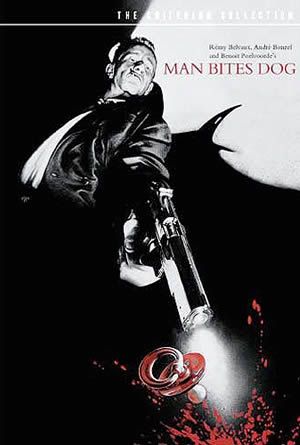
Man Bites Dog

Film: Man Bites Dog - aka - C'est arrivé près de chez vous (1992)
Dir: Rémy Belvaux, André Bonzel, Benoît Poelvoorde
Rating: ** out of 5 stars


Man Bites Dog has a certain reputation. If the cover art of a man shooting a baby point-blank in the face wasn't indication enough, the movie is known for being fucked up. And while that scene on the cover never actually occurs, the film is indeed pretty disturbing. Needless to say, I was drawn to it for that reason. Unfortunately, most of the movie is boring and without substance. I like the general concept and how it is executed so realistically, but in the end, it all felt pointless.

The film is a fake documentary following a serial killer named Benoît (Ben, for short). He shows the film crew how he attacks random mailmen, kills and robs old ladies, and other horrific acts. It is obvious he enjoys his "work" - he jokes throughout and will go out for drinks after a murder. He takes pride in killing victims in unique ways and encourages the film crew to partake. Eventually, they do get very involved and start to really enjoy it, as well.

If you didn't know better, you might not know this documentary is fake because it is shot so realistically. Even the lead "actors" are the real directors and use their actual names in the film. The murder scenes are also pretty realistic. Man Bites Dog touches on a very interesting topic - society's fascination with voyeurism and violence. However, it never seemed to reach an actual point and instead comes across like cheap shock schlock.

One scene in particular is very disturbing, where a woman is raped (and ultimately killed) while her husband watches at gunpoint. For me, this scene felt completely unnecessary. Don't get me wrong, I don't have a weak stomach. One of my favorite films of all time is A Clockwork Orange, so I can handle violent rape scenes. The difference between that film and Man Bites Dog is the former had a moral pay-off. Kubrick made me watch these horrific scenes of violence, but it had a purpose and I felt like I got something in return emotionally. In this film, however, the rape is superfluous and does nothing for the story. So I just feel angry for having been made to watch it.

Another one of the film's biggest flaws is its lead subject - Ben. The story would have been more effective if he was a genuinely likable character. The filmmakers were clearly trying to make him charismatic so that the viewer would feel ethically conflicted for liking him. But in reality, Ben is a racist, vulgar, insulting, thieving, raping asshole. These traits makes the killing part less shocking and I never felt that moral ambiguity. Furthermore, his dickish behavior makes it less believable that the film crew would get so swept up in "the fun" of his antics.

This movie has often been called a black comedy, but it is only occasionally funny. I was largely bored by the slow pacing and redundant kill after kill after boring kill. It felt 60 minutes too long, and thus probably would've made for a decent short film. I can appreciate what the filmmakers were going for, but unfortunately they did not quite achieve it.

Sunday, January 27, 2008

Rambo

Film: Rambo (2008)
Dir: Sylvester Stallone
Rating: **** out of 5 stars


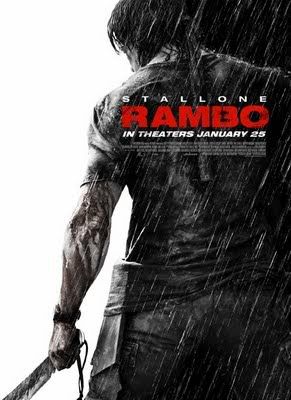
Rambo is not destined for Oscar gold or critical praise, but that won't stop it from being one of my favorite movies of this year. It is like a textbook example on how to make one fantastic fucking action movie. I'd call it a guilty pleasure, except that I feel no sense of guilt for loving it. It is not for everybody, but for a gore whore like me, this is pure, unfiltered awesome.

John Rambo is living a quiet life in the Burma jungle, wrangling cobras for a living (a job for a true badass). A group of missionaries asks him to escort them into a warzone so they can help the villagers, who are being marauded by an oppressive government militia. At first he refuses to get involved, for their own safety, but eventually he relucantly agrees. So of course the stupid missionaries get kidnapped by cruel Burmese soldiers, and it's up to Rambo to rescue them. Just to make things even more badass, he gets help from a team of highly-trained mercenaries.

Rambo includes actual footage of war-ravaged villages, as Stallone was clearly trying to shock his audience with real world horror. Even the staged acts of violence in the film are pretty horrifying. So the film evokes that same feeling you get watching Saving Private Ryan or Schindler's List, except Rambo gives us the ending we only wish would happen in real life - a badass motherfucker showing up and completely wrecking the bad guys. The villains in this are SO evil that it makes the revenge that much sweeter. Perhaps the moral relevance is lost in all the gratuitous kills, but it is so damn satisfying on a visceral level.

There are slow parts where the story dominates, but they are always punctuated with some great moment of Rambo ripping someone's throat out or obliterating someone with a 50-cal machine gun. The last ten minutes or so are just about the most fun I've had watching a movie in some time. It is an absolute massacre of bad guys in so many colorful ways. I was very impressed with the visual FX - with the exception of one or two bad CGI shots, the gore is phenomenol. Very brutal and very realistic.

I'm sure I sound like a complete sicko for enjoying the carnage so much, but put this movie on in a room full of people and watch the wild reactions it will elicit. The violence is so, so extreme and so, so satisying because the bad guys are absolute assholes. I've seen enough depressing films about the victims of genocide - it's about damn time we saw the murdering dickheads getting their asses handed to them. And who better to do it than Rambo?